
Aluminum Foam for Noise Control: Metro Stations, Machine Rooms and Acoustic Enclosures
Why Noise Control Is an Engineering Problem, Not a Comfort Problem
In metro stations, power plant machine rooms, compressor houses and generator enclosures, noise is regulated, measured and often contractual. Reverberation inside a hard-surfaced station hall can push speech intelligibility below usable levels; a compressor room that exceeds local occupational noise limits can force operator rotation or fines. Traditional absorbers — mineral wool, glass wool, fabric-wrapped foam — absorb sound well, but they bring three liabilities into a public or industrial space: they are combustible or only Class B rated, they degrade with moisture, and they shed fibers that complicate maintenance.
Open-cell aluminum foam has moved from a research material to a mainstream answer for exactly these environments. It absorbs broadband noise (NRC ≥ 0.75 in typical 20–25 mm open-cell panels), it is A1 non-combustible under both GB 8624 and EN 13501-1, it does not absorb water or shed fibers, and it survives decades in high-humidity, high-traffic environments. The building-construction segment for aluminum foam alone is estimated at roughly USD 173 million in 2026 with a 7.5% CAGR — growth driven primarily by acoustic and fire applications in transport and industrial buildings.

How a Metal Absorbs Sound
The counterintuitive part is that a metal can absorb sound at all. The answer is the cell structure. In open-cell aluminum foam — density typically 0.25–0.85 g/cm³, porosity 68–91% — the cells are interconnected, so sound waves enter the pore network and lose energy through viscous friction against the cell walls and thermal exchange as the air is compressed and expanded millions of times per second. The acoustic energy is converted to a negligible amount of heat.
Three practical consequences follow:
- Absorption, not blocking. A bare 20 mm open-cell panel absorbs incident mid-to-high frequency energy with an NRC of 0.75 or better, but its transmission loss is modest. For wall build-ups where sound must be blocked as well as absorbed, aluminum foam is used as the absorptive core of a sandwich panel — two thin face sheets over a foam core — which reaches weighted sound reduction indices around Rw ≈ 28 dB while remaining rigid enough to be self-supporting.
- Thickness sets the low-frequency cutoff. Absorption at 250 Hz and below requires thickness or an air gap behind the panel. A common specification is 20–25 mm foam mounted 50–100 mm off a hard wall on furring, which extends effective absorption down an octave without adding material cost.
- It is also an EMI shield. A continuous metal foam attenuates electromagnetic radiation by roughly 40–55 dB across a broad range — a free secondary benefit in machine rooms housing drives, inverters and switchgear.
Closed-cell foam behaves differently. Its sealed pores give better stiffness-to-weight for structural sandwich cores and better moisture sealing, but noticeably less acoustic absorption. Buyers who specify "aluminum foam panel" without the open/closed distinction regularly receive the wrong product. If the target is noise, the specification should read "open-cell, interconnected porosity," backed by a measured NRC or absorption coefficient curve — not a vendor's generic datasheet.
Application 1: Metro and Rail Stations
Underground stations concentrate every acoustic problem at once: hard tiled surfaces, high passenger volumes, PA announcements that must remain intelligible, and a fire code that permits almost nothing flammable near the platform ceiling. Aluminum foam ceiling and wall panels address all three constraints simultaneously:
- A1 non-combustible. EN 13501-1 Class A1 and GB 8624 Class A ratings are accepted by metro authorities that reject polymer foams outright, even fire-retarded ones. There is no smoke or dripping contribution in a fire scenario.
- Vandalism and impact resistance. Unlike perforated metal backed by mineral wool — where the soft backing can be torn out — the absorbing layer in aluminum foam is the panel. Cleaning with high-pressure washers and industrial detergents does not degrade it.
- Service life. Aluminum does not rust, rot or support mold. Stations installed with foam ceilings more than a decade ago show no measurable loss of absorption, which matters because acoustic retrofits in an operating metro require night possessions and costs that dwarf the panel price.
A typical platform installation uses 20–25 mm open-cell panels in 600 × 1200 mm or 1000 × 2000 mm modules, powder-coated in RAL colors (the coating barely affects absorption), suspended on a standard ceiling grid with the recommended rear air gap. The visible result reads as a metallic architectural finish; the measured result is reverberation time reductions of 40–60% in a treated hall.
Application 2: Machine Rooms and Generator Enclosures
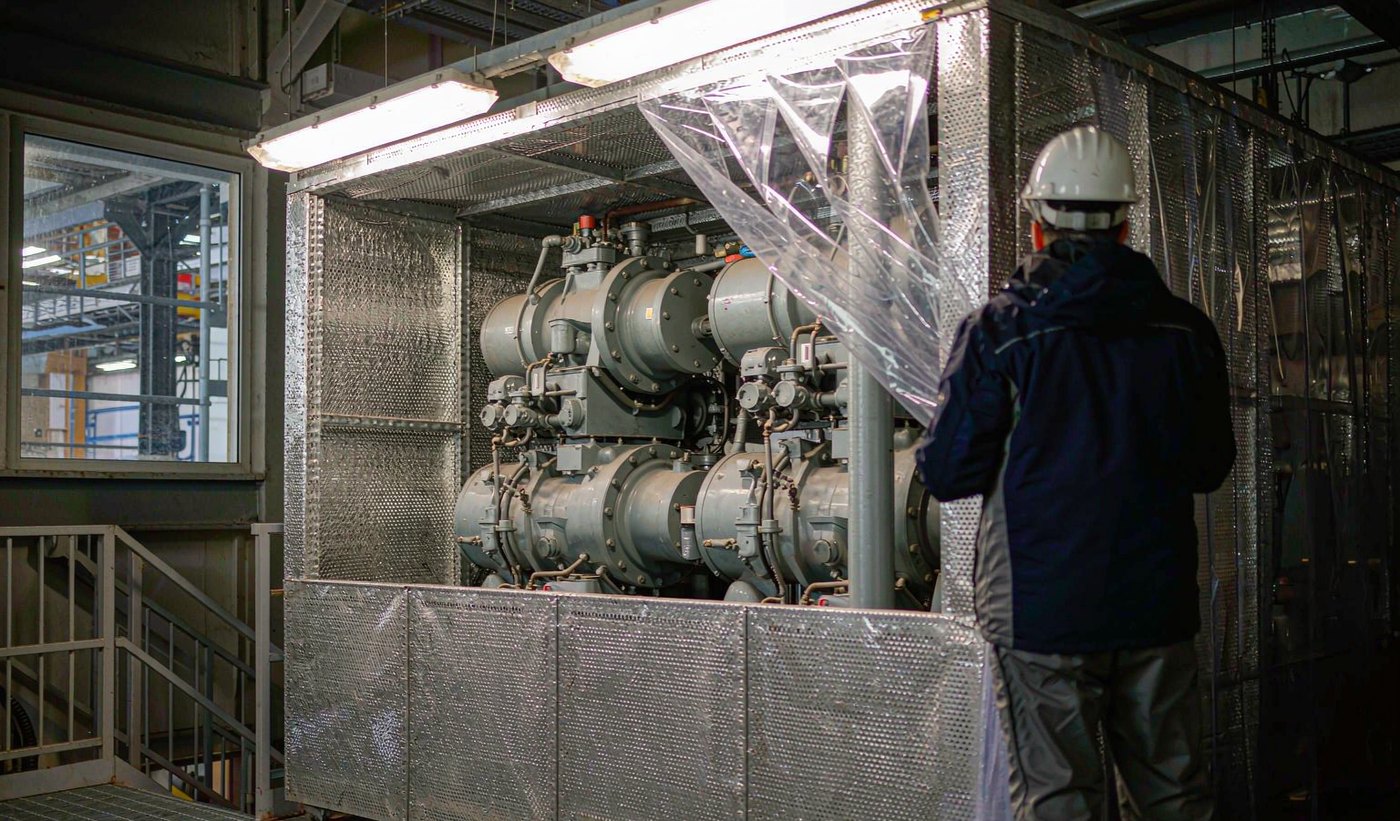
Compressor houses, pump rooms, generator enclosures and fan plenums are the second major use case. Here the drivers are occupational noise limits and, increasingly, community noise limits on plant boundaries. Aluminum foam earns its place through a combination of properties no competing absorber offers at once:
- Heat and oil resistance. Linings near engine exhausts, turbochargers and hot ducting face 150–300°C surfaces. Mineral wool survives the temperature but sheds fibers into airflow; polymer foams simply cannot be used. Open-cell aluminum foam is dimensionally stable far beyond these temperatures.
- Washdown compatibility. Enclosures can be specified with panels that are hosed down during maintenance without absorbing water or losing performance — relevant in food-processing plants and offshore environments.
- Combined acoustic + EMI function. A test-cell or VFD room lined with aluminum foam gets broadband absorption (cutting the reverberant build-up that dominates measured SPL) together with 40–55 dB of electromagnetic shielding from the same lining.
- Structural sandwich enclosures. For full acoustic enclosures around a genset, foam-cored sandwich panels form self-supporting walls and doors with Rw ≈ 28 dB per leaf; stacked with an air gap and a second leaf, the assembly exceeds Rw 45 dB without any fibrous insulation inside.
Application 3: Equipment Cabinets and Stainless Steel Composites
The third application connects directly to stainless steel fabrication. When aluminum foam is bonded between two stainless steel face sheets, the resulting sandwich panel combines the corrosion resistance and hygiene of stainless steel with the stiffness, damping and absorption of the foam core. Real uses include:
- Acoustic equipment cabinets — outdoor telecom and inverter cabinets where the stainless skin handles weather and the foam core damps panel resonance and absorbs fan noise.
- Vibration-damped doors and panels — a foam-cored stainless door leaf rings far less than a hollow or honeycomb leaf when struck, an audible quality cue in premium equipment.
- Machinery cladding in hygienic plants — washdown-safe, fiber-free acoustic lining around equipment in food and pharmaceutical facilities, where mineral wool is prohibited in process areas.
Specification Checklist for Buyers
When sourcing aluminum foam acoustic panels or sandwich panels, the following points separate a specification that performs from one that gets value-engineered into failure:
- Cell type: open-cell for absorption; closed-cell only for structural or sealing cores. Ask for the porosity figure (68–91% is the normal open-cell range) and a measured absorption curve per ISO 354 or ASTM C423, not just an NRC single number.
- Fire certification: request the actual EN 13501-1 or GB 8624 classification report for the finished panel, including any coating — a Class A1 foam behind a poorly chosen coating is not a Class A1 system.
- Thickness and mounting: specify the rear air gap; the same panel mounted flush versus 50 mm off-wall performs differently below 500 Hz.
- Face sheet bonding: for sandwich panels, confirm the bonding process (adhesive film versus roll-bonding) and peel strength; acoustic damping depends on the core working with the skins.
- Corrosion environment: bare aluminum foam suits most indoor and transport applications; for chloride-exposed or coastal sites, specify coated panels or stainless-clad composites.
A Note on Cost — and Why It Is the Wrong First Question
Open-cell aluminum foam currently costs roughly 2–4 times ordinary solid aluminum sheet per square meter, and buyers who anchor on that comparison reject it. The correct comparison is against the installed system it replaces: perforated metal + mineral wool + vapor barrier + mesh backing, plus the access cost of replacing fiber-degraded backing every several years in a humid station, plus the fire-engineering cost of proving a Class B polymer alternative acceptable to an authority that will likely say no. On that basis, the foam panel frequently wins on 10-year cost — and wins outright on fire approval, where it is often the only material that passes without exception paperwork.
Summary
Aluminum foam has crossed from novelty to specified material in three noise-controlled environments: metro and rail stations (A1 fire rating + durable absorption), machine rooms and generator enclosures (heat/oil/washdown resistance + EMI shielding), and stainless-steel-clad equipment (damping + hygiene). The engineering fundamentals are stable and well documented: open-cell structure for absorption, NRC ≥ 0.75 at 20–25 mm, Rw ≈ 28 dB in sandwich form, A1 classification, and effective service life measured in decades. For importers and contractors, the two decisions that determine success are specifying open-cell with measured absorption data, and matching the panel system — thickness, air gap, coating, face sheets — to the environment rather than to the datasheet.
📞 Contact FSGood Steel immediately to obtain a quote or technical consultation:
📧 Email – jason@fsgoodsteel.com
📱 Phone – +86 18370137709
💬 WhatsApp - +86 18007093101
🌐 Website – www.fsgoodsteel.com