
Stainless Steel Coil Price Factors: What Really Determines the Final Cost?
Stainless Steel Coil Price Factors: What Really Determines the Final Cost?
When international buyers request a stainless steel coil quotation, the first number they usually compare is the price per ton.
However, stainless steel coil pricing is influenced by much more than the material grade alone. Thickness, width, surface finish, processing requirements, order quantity, packaging, logistics, and market conditions can all affect the final purchasing cost.
For importers, distributors, fabricators, and manufacturers, understanding these factors makes it easier to compare supplier quotations and avoid choosing a quotation that appears inexpensive but results in a higher total cost.
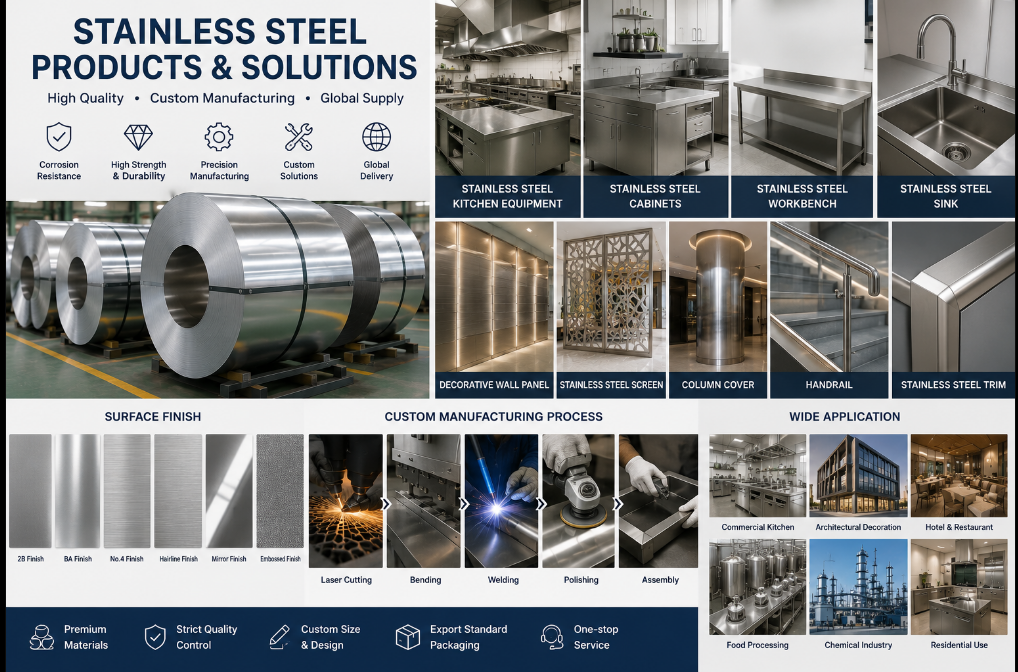
What Determines Stainless Steel Coil Price?
The final price of stainless steel coil is generally influenced by several major factors:
Stainless steel grade
Raw material and alloy composition
Thickness
Width
Surface finish
Production and processing requirements
Order quantity
Packaging
Delivery terms
Shipping destination
Market conditions
Two quotations for “304 stainless steel coil” may therefore have noticeably different prices even when the product description initially looks similar.
The key is to compare the same technical and commercial specification.
1. Stainless Steel Grade
Grade is one of the most important price factors.
Common grades such as 201, 304, and 316 have different chemical compositions and alloy costs.
For example, 316 stainless steel contains molybdenum and is commonly selected for applications requiring higher resistance to chloride-containing environments.
304 is widely used for general corrosion-resistant applications, kitchen equipment, architectural fabrication, and industrial components.
201 is often selected when buyers are looking for a more cost-sensitive stainless steel option for suitable applications.
The correct grade should therefore be selected based on the actual application rather than simply choosing the cheapest material.
2. Stainless Steel Thickness
Thickness has a direct influence on the amount of material contained in a coil.
A 2.0 mm stainless steel coil contains significantly more material per square meter than a 0.8 mm coil of the same width.
When comparing quotations, buyers should make sure the thickness specification is identical.
For example, comparing:
304 × 0.8 mm
304 × 1.0 mm
304 × 1.5 mm
as though they were the same product can produce misleading conclusions.
Thickness tolerance should also be considered because the actual delivered material may differ from the nominal thickness within the applicable standard or agreed tolerance.
3. Coil Width
Width is another important factor.
Common stainless steel coil widths include 1000 mm, 1219 mm, 1250 mm, 1500 mm, and customized widths.
A standard mill width may sometimes be more economical than a special width because customized widths can require additional processing or slitting.
If the final product does not require a highly specific width, asking the supplier about available standard widths can sometimes improve material utilization and reduce processing costs.
4. Surface Finish
Surface finish also affects the quotation.
Common stainless steel finishes include:
2B
BA
No.4
Hairline
Mirror
A standard 2B cold rolled coil and a decorative polished or brushed product may have substantially different processing requirements.
When requesting a quotation, buyers should clearly specify the required surface finish rather than simply asking for a grade.
This makes supplier quotations easier to compare.
5. Cold Rolling and Additional Processing
The manufacturing route can influence cost.
Depending on the product specification, stainless steel may require processes such as:
Cold rolling
Annealing
Pickling
Skin pass
Slitting
Grinding
Brushing
Polishing
Leveling
Additional processing means additional production time, equipment usage, inspection, and handling.
For this reason, buyers should determine which processes are actually necessary for their final application.
6. Order Quantity
Order quantity can influence the supplier's production economics.
A larger order may allow production and logistics costs to be distributed across a greater volume.
Small orders, however, can still be commercially useful for:
Market testing
New product development
Sample production
Trial orders
Small fabrication projects
Instead of asking only for the lowest possible price, buyers should ask suppliers how pricing changes at different quantities.
For example:
5 MT vs 10 MT vs 20 MT
This can reveal the relationship between quantity and unit cost.
7. Slitting and Customized Widths
If a buyer requires slit coils rather than standard master coils, additional processing may be necessary.
Slitting can affect the final price because it involves:
Machine setup
Knife configuration
Processing time
Width tolerances
Edge quality
Recoiling
Packaging
The cost should therefore be evaluated together with the required slit width and tolerance.
8. Packaging Requirements
Packaging is sometimes overlooked during price comparisons.
Export stainless steel coils may require appropriate protection against:
Moisture
Surface damage
Handling impact
Transportation movement
Environmental exposure
Packaging requirements can vary according to shipping method, destination, product finish, and buyer expectations.
A quotation with minimal packaging may appear cheaper but may not provide the same level of protection as a quotation with export-oriented packaging.
9. Shipping and Incoterms
The stainless steel coil price is only one part of the buyer's total purchasing cost.
Depending on the quotation terms, buyers may receive:
EXW
FOB
CFR
CIF
Other agreed delivery terms
These terms determine which logistics costs are included in the quoted price.
For international procurement, buyers should compare quotations on the same basis.
For example, comparing a FOB quotation directly against a CIF quotation without accounting for freight can lead to the wrong purchasing decision.
10. Destination and Freight Cost
The final landed cost also depends on the destination.
Freight can vary according to:
Destination port
Container type
Shipment weight
Shipping schedule
Freight market conditions
Inland transportation
Port charges
For heavy stainless steel products, logistics can represent a meaningful part of the total procurement cost.
This is why buyers should evaluate the material quotation together with shipping rather than considering the material price in isolation.
Why the Lowest Stainless Steel Coil Price Is Not Always the Best Deal
Suppose Supplier A quotes USD X per ton while Supplier B quotes slightly more.
At first glance, Supplier A appears cheaper.
But if Supplier A has:
Higher thickness variation
More surface defects
Less suitable packaging
Longer lead time
Higher processing loss
Less consistent quality
the apparent price advantage may disappear after the material reaches the buyer's factory.
A professional purchasing decision should therefore consider:
Material price + quality + usable yield + processing + logistics + delivery reliability
rather than simply choosing the lowest number.
How to Compare Stainless Steel Coil Quotations
A useful comparison sheet should contain at least:
| Specification | Supplier A | Supplier B |
|---|---|---|
| Grade | 304 | 304 |
| Thickness | 1.0 mm | 1.0 mm |
| Width | 1219 mm | 1219 mm |
| Finish | 2B | 2B |
| Standard | Specified | Specified |
| Quantity | 20 MT | 20 MT |
| Packaging | Export | Export |
| Price Basis | FOB | FOB |
| Lead Time | Confirm | Confirm |
| Payment Terms | Confirm | Confirm |
Only after these specifications are aligned can buyers make a meaningful price comparison.
How to Reduce Stainless Steel Coil Procurement Cost
There are several practical ways buyers can control purchasing costs without simply demanding a lower material price.
Use the Correct Grade
Avoid purchasing a higher-cost grade when the application does not require it.
Optimize Thickness
Review whether the final product really requires the specified thickness.
Consider Standard Widths
Standard widths may reduce unnecessary slitting and improve material utilization.
Consolidate Orders
Combining suitable requirements into a larger order may improve production and logistics efficiency.
Confirm Surface Requirements
Do not pay for a decorative surface finish when a functional finish is sufficient.
Compare Landed Cost
Consider material, processing, packaging, freight, and other relevant costs together.
Work With a Consistent Supplier
Stable quality and predictable delivery can reduce hidden costs associated with rejected material, production interruptions, and urgent replacement orders.
What Should Be Included in a Stainless Steel Coil RFQ?
For an accurate quotation, buyers should provide:
Grade
Thickness
Width
Surface finish
Quantity
Required standard
Coil or slit coil requirement
Packaging requirements
Destination port
Delivery terms
Target delivery date
The more complete the RFQ, the easier it is for suppliers to provide a comparable commercial offer.
Final Thoughts
Stainless steel coil pricing is not determined by grade alone.
A professional buyer should evaluate the complete specification, including material grade, thickness, width, surface finish, processing, quantity, packaging, delivery terms, and logistics.
The best supplier is not necessarily the one offering the lowest price per ton. The better choice is usually the supplier that provides the right material specification, consistent quality, predictable delivery, and competitive total landed cost.
For long-term stainless steel procurement, cost control starts with specification control.
📞 Contact FSGood Steel immediately to obtain a quote or technical consultation:
📧 Email – [sales@fsgoodsteel.com]
📱 Phone – [+86 18370137709]
💬 WhatsApp - [+86 18007093101]
🌐Website – www.fsgoodsteel.com