
Why Stainless Steel Coils Arrive Rusty: Anti-Rust Packing and Sea-Freight Protection That Works
Stainless steel does rust in a container. Not because the mill sold you the wrong grade, but because a coil can spend 25–40 days inside a steel box crossing the tropics, breathing humid air, sitting on a damp floor, wrapped in paper that was never specified for the voyage. Every year buyers open a container in Rotterdam, Melbourne or Los Angeles and find white rust blooming along the edges, tea-coloured water stains between wraps, or brown bleed marks where a strap rubbed through the film. By then the goods are on your dock, the balance is paid, and the argument about who owns the loss has begun.
This guide is written from the loading bay side: what actually causes transit corrosion on stainless coils and sheets, what a proper sea-freight packing specification looks like, and which clauses to put into your purchase order so the risk sits with the party that controls it.
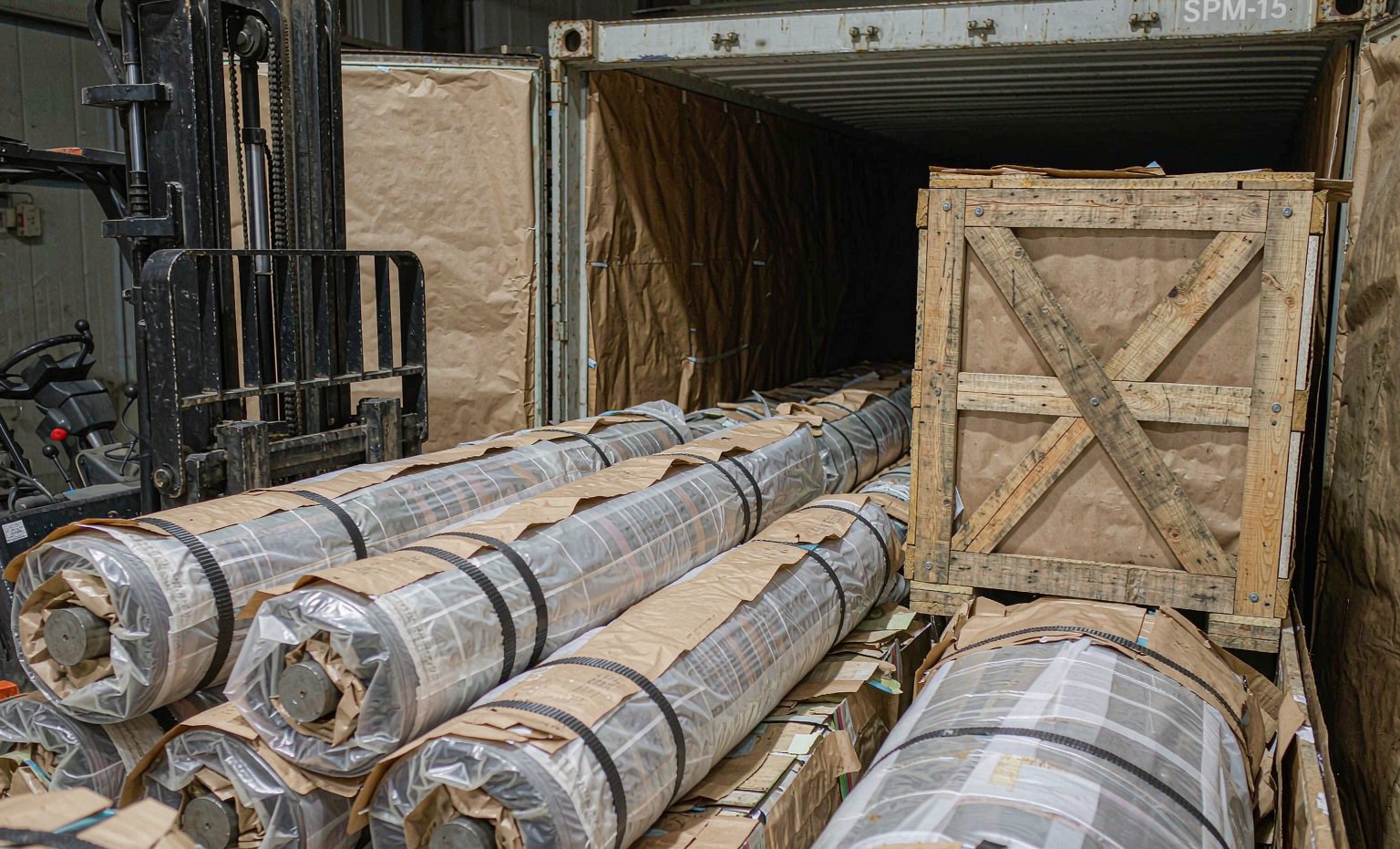
1. Stainless steel is corrosion-resistant, not corrosion-proof
The passive chromium oxide layer on 304 or 316L is roughly 1–3 nanometres thick. It repairs itself in the presence of oxygen, which is why stainless performs well in open air and poorly in a closed, humid, chloride-bearing environment — exactly what a container is.
Three mechanisms account for most arrival claims:
- Condensation cycling ("container rain"). A container loaded in a warm, humid mill yard can hold 100–200 g/m³ of water vapour. As the ship moves into cooler latitudes, that vapour condenses on the coldest surface — usually the steel itself. Water runs down the wraps and pools at the bottom of the coil eye.
- Chloride concentration. Sea air, forklift tyre spray, dirty container floors and even handling gloves carry chlorides. Once moisture is present, chlorides break down the passive layer locally and produce pitting or "white rust" on galvanised-adjacent material and staining on 2B surfaces.
- Mechanical damage that becomes chemical damage. A strap that cuts the film, an edge dinged by a fork pocket, a crate board rubbing for three weeks — each creates a path for water and a site for crevice corrosion. Water trapped under a broken wrap cannot dry, and that is where the rust appears.
Note the pattern: the failure is rarely the grade. It is the packaging system and the container environment.
2. The six points where sea-freight protection fails
| Failure point | What goes wrong | What good practice looks like |
|---|---|---|
| Mill wrap / inner packing | Single layer of kraft paper, no barrier film, open ends | VCI film or VCI paper directly on the surface, then waterproof paper, ends folded and taped |
| Coil eye | Open bore collects condensation and is impossible to dry | Cardboard or plastic bore protector, desiccant sachet inside the eye for long voyages |
| Edges | Edge knocks tear the wrap and start crevice corrosion | Plastic or hardboard edge protectors on both rims, corner boards on sheet bundles |
| Strapping | Steel strap bites into the wrap; rust from the strap stains the surface | PET strap over edge protectors, or steel strap with plastic strapping shields |
| Container | Damp floor, holes in the roof, residues from the previous cargo | Container inspection before loading, kraft paper or plywood lining on floor and walls |
| Atmosphere | No desiccant, loaded in rain, doors closed with wet cargo inside | Calculated desiccant load, loading under cover, container desiccant bags hung at door end |
3. Specifying packing by surface finish
Packing cost should scale with how visible and how repairable the surface is. A 2B coil for a hidden structural part tolerates a simpler wrap than an 8K mirror sheet for a hotel lobby.
- 2B / 2D (cold rolled, annealed and pickled): VCI film plus waterproof paper is normally sufficient. Most white-rust claims on 2B arise from wet loading and missing desiccant rather than from the wrap itself.
- BA / No.4 / hairline: add interleaving paper between sheets, and specify that the protective film is PE-based and removable without adhesive residue. Hairline finishes show every handling mark, so edge protection matters more than film thickness.
- 8K mirror / super-mirror: laser-cut PVC film on the polished face, paper on the reverse, crate packing rather than bundle packing. Specify film adhesion grade — cheap film leaves glue that cannot be removed without re-polishing.
- Embossed, coloured and anti-fingerprint (AFP) coils: the textured or coated surface traps water in the pattern; require a full wrap plus desiccant and avoid flat-stacked storage at the port.
Thickness and width change the mechanics too. Wide, thin coil (for example 0.5 mm × 1250 mm) deflects under its own weight and crushed edges are common; specify a steel or plywood cradle, not just a wooden skid.
4. Packaging types and when each is justified
Eye-to-sky (vertical) packing places the coil axis vertical, resting on a wooden pallet with a central support. It is faster to handle, but the coil bears load on its own edge and the bottom rim is exposed. Suitable for thicker coil and short sea legs.
Eye-to-wall (horizontal) packing lays the coil on its side in a cradle, spreading load across the wrap face. Better for thin, wide and surface-critical coil, and the standard choice for mirror and BA material.
Wooden crates / cases are justified for high-value or finish-critical goods, for LCL shipments where cargo is handled repeatedly, and for multi-modal routes with transhipment. Two practical points: timber must carry ISPM-15 heat-treatment marking (Australia, the EU and the US all enforce this), and crates must be designed for forklift access from two sides — a crate that can only be lifted one way will be dragged.
Container desiccant is the cheapest insurance in the shipment. A common working rule is 1–2 kg of container desiccant per 20 ft for a 20–30 day voyage in temperate-to-tropical routing, more where cargo was loaded in high humidity. Desiccant must be hung at the door end and along the side walls, not buried under the cargo where it cannot circulate.
5. What to write into the purchase order
Vague packing language is the reason claims fail. Instead of "standard export packing", specify the system. A clause that has held up in practice reads like this:
Each coil to be wrapped in VCI film in direct contact with the surface, over-wrapped with two layers of waterproof kraft paper, ends folded and sealed with waterproof tape. Plastic edge protectors on both rims. PET strapping with strapping shields, minimum three bands per coil. Coil eye protected with a bore insert and 100 g desiccant. Coils to be eye-to-wall packed in ISPM-15 heat-treated wooden cradles. Container to be inspected before loading, floor and walls lined with kraft paper, minimum 8 kg container desiccant per 40 ft. Loading under cover; no loading during rain. Photographs of packing and container closing to be provided before departure.
That last sentence is worth more than the rest. Photographic evidence of packing and door-closing, timestamped before the vessel sails, settles most arguments about whether damage occurred before or after handover.
6. Receiving inspection: the first 48 hours decide the claim
- Photograph the container before opening — doors, seals, container number, and any visible damage or staining on the floor.
- Check for condensation on the door interior and on the outer wrap. Water droplets at this stage are strong evidence of a container-atmosphere problem, not a mill defect.
- Inspect by layer. Damage is often confined to the bottom tier and the door-end coils, which tells you whether the cause was floor moisture or door breathing.
- Record the pattern, not just the fact. Edge staining on every coil suggests wrap failure; isolated pitting on one coil suggests handling damage or contamination.
- Notify within the contractual window — typically 7–15 days — and request a joint survey before any material is processed, cut or re-polished. Once you cut the coil, most insurers and most sellers will decline liability.
7. Is the extra packing worth it?
Run the arithmetic once. Take a 20 tonne 304 2B coil order at around USD 2,600/t FOB, roughly USD 52,000 of cargo. Upgraded packing — VCI film, crates, desiccant, photographic record — might add USD 15–35 per tonne, or USD 300–700 on the order. A single rejected coil, a re-polishing operation, or a two-week delay on a project site usually costs more than that in the first day.
The commercial point is not that packing is cheap. It is that the cost is predictable, small and negotiable, while the cost of a claim is unpredictable, large and disputed.
8. Questions to ask before you book the shipment
- Which packing system is quoted, and is it the same for every tier in the container?
- Is the timber ISPM-15 treated, and will the marking be photographed?
- How much desiccant is used per container, and where is it placed?
- Will you send loading photos, including the closed doors and seal number, before departure?
- What is the claim notification window in your contract, and who bears survey costs?
- For surface-critical material: is the protective film removable without adhesive residue, and for how long?
If the answers are specific, you are dealing with a supplier who has handled claims before. If they are vague, the packing clause in your PO is doing all the work — and so is your insurance.
For the wider logistics picture — container loading plans, port handling and documentation flow — see our guide on stainless steel coil packaging and international shipping, and for cost planning, our breakdown of how to calculate the landed cost of a stainless steel coil.
📞 Contact FSGood Steel immediately to obtain a quote or technical consultation:
📧 Email – jason@fsgoodsteel.com
📱 Phone – +86 18370137709
💬 WhatsApp - +86 18007093101
🌐 Website – www.fsgoodsteel.com