
Stainless Steel Surface Finish Guide: How to Specify 2B, BA, No.4, HL and No.8 Without Overpaying
By Jason, goodsteel Technical Analysis Department | 2 November 2026
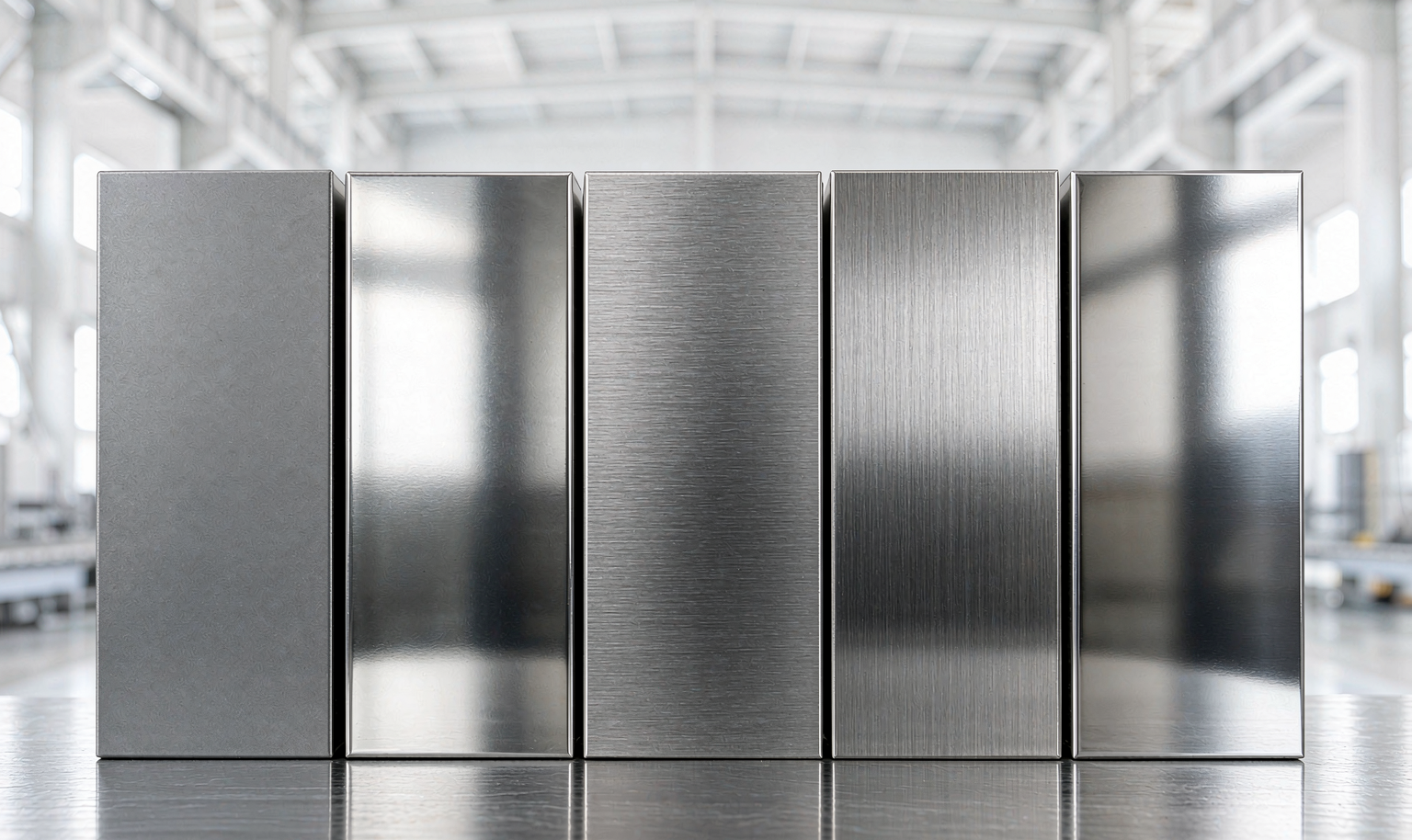
Most buyers spend their negotiating energy on the grade and the price per tonne. Then the container opens, and the argument starts: the panels are matte where they should be bright, the brushed grain runs across the elevator car instead of along it, or the mirror sheets arrive hazy under the protective film.
Chemistry is correct. Mechanicals are correct. The material is still rejected.
Surface finish is the single most mis-specified line item in stainless flat-product purchasing, and it is the one that most directly converts into rework, delay and claims. Here is how to specify it properly — and, in the current market, how to stop paying for finish you do not need.
Where the market stands this week (data as of 2 November 2026)
| Indicator | Latest reading | Direction |
|---|---|---|
| 304/2B 2.0 mm cold-rolled, Wuxi | RMB 13,500–13,900/t (Delong, Yongjin) | −RMB 50 day-on-day |
| 304/2B 2.0 mm cold-rolled, Foshan | RMB 13,750–14,200/t (Delong, Hongwang, Yongjin) | Flat to soft |
| 316L/2B 2.0 mm, Foshan | RMB 29,000–29,100/t | −RMB 500 week-on-week |
| Stainless futures, main contract | RMB 13,515/t | +0.86% |
| High-grade NPI (SMM 10–12%) | RMB 1,011.2 per nickel unit, ex-works incl. tax | −2.5 week-on-week |
| Indonesia NPI FOB index | US$131.2 per nickel unit | −0.1 week-on-week |
| High-carbon ferrochrome, Inner Mongolia | RMB 7,450 per 50 kg basis | −RMB 75 week-on-week |
| LME nickel stocks | 278,238 t | −552 t |
| National stainless social inventory | 1.0969 Mt (29 Oct) | −2.00% week-on-week, third straight decline |
Two conclusions follow. First, 304 is at a cost-driven low: nickel unit costs, ferrochrome and mill offers are all falling together, and the cost floor is still moving down. Second, 316L is decoupling — molybdenum, not nickel, is now the swing factor. Molybdenum averaged roughly US$65,780/t globally in Q2 2026 and is projected at US$66,000–80,000/t for H2, with China the most expensive market at US$74,000–90,000/t. Outokumpu, Aperam and Acerinox all raised 316 prices for November on higher molybdenum and tight 316 scrap, while 304 moved in different directions by producer.
For a buyer, this asymmetry matters: locking a decorative 304 programme now is materially cheaper than it has been, while 316L surcharges should be assumed volatile.
A finish is not a coating
A stainless finish is the physical condition left by the rolling and processing route. Think of it in two layers:
- The mill base — the texture left by cold rolling, annealing, pickling and the final skin pass. This is 2B or 2D.
- The secondary process — bright annealing, belt polishing, brushing, or progressive buffing applied on top of the base.
Everything downstream — reflectivity, cleanability, corrosion behaviour, weldability, fabrication tolerance and price — follows from that combination.
The five finishes you will actually be quoted
| Finish | How it is made | Surface roughness Ra | Typical use | Indicative cost impact |
|---|---|---|---|---|
| 2B | Cold rolled, annealed, pickled, light skin pass | 0.1–0.5 µm | Tanks, process equipment, hidden panels, further-polish stock | Baseline |
| BA | Bright annealed in protective atmosphere; no pickling | 0.05–0.15 µm | Appliance panels, medical, architectural trim | Typically +10–20% over 2B |
| No.4 | Mechanical belt polish, ~150–180 grit, on 2B base | 0.2–0.5 µm | Commercial kitchens, elevators, food-contact surfaces | Secondary-process premium plus lead time |
| HL (hairline) | Finer continuous belt, ~220–320 grit | 0.1–0.3 µm | Curtain wall, handrails, premium interiors | Similar band to No.4 |
| No.8 mirror | Progressive polish plus buffing, non-directional | <0.05 µm | Decorative panels, signage, feature walls | Commonly +40–80% over base material |
Cost premiums are trade ranges, not fixed numbers: they vary with gauge, sheet size, order tonnage and whether the finish is applied at the mill or at a service centre.
Three places buyers lose money
1. Mirror specified for structural work. No.8 is bought for appearance. In a structural or industrial environment it adds cost, lead time and — because it shows every fingerprint and handling mark — ongoing maintenance. If the surface is not seen, 2B is the correct answer.
2. BA treated as an automatic upgrade. BA skips pickling and looks excellent, but for general fabrication it is not automatically superior to 2B. It is a specification for reflectivity and cleanability, not a quality tier.
3. Finishing ordered before fabrication. Every weld, bend, laser cut and handling step damages a polished surface. Where the part is welded and then dressed, finishing the fabricated assembly — or protecting it with PVC film and accepting a final local polish — often costs less than replacing damaged pre-finished sheet.
Finish is also a compliance variable
Finish is not cosmetic only. Lower roughness means fewer crevice-initiation sites and easier cleaning, which is why food-contact and pharmaceutical specifications routinely name No.4 or BA rather than 2B. If your application has a hygiene requirement, the finish belongs in the compliance file, not just the drawing.
Trade policy now sits on top of that. Japan's Cabinet published a definitive anti-dumping order on 30 October 2026 covering nickel-bearing cold-rolled stainless coil, sheet and strip (chromium ≥10.5%, nickel >0.6%; HS 7219.31–7219.35, 7219.90, 7220.20, 7220.90). It applies from 31 October 2026 to 30 October 2031 at 27.7% for Shanxi Taigang and non-sampled suppliers and 42.1% for POSCO Zhangjiagang and other suppliers; Hong Kong SAR and Macao SAR are excluded. Because the duty is ad valorem on cold-rolled flat product, the finish value you add before export is also inside the duty base — a reason to review where polishing is performed for Japan-bound tonnage.
Separately, the EU CBAM has applied to stainless imports since 1 January 2026, and the UK introduces its own CBAM for iron and steel on 1 January 2027. Neither changes your alloy surcharge, but both add origin- and emissions-dependent landed cost.
How to write the finish line in your RFQ
Do not write "surface good" or "brushed". Write:
Material: ASTM A240 / EN 10088-2, Grade 304L (1.4307), thickness 1.5 mm × 1219 mm × C.
Finish: No.4, ASTM A480, unidirectional, longitudinal grain, 180 grit.
Surface roughness: Ra ≤ 0.4 µm, verified on three points per coil.
Protection: PVC laser film, 50 µm, applied on the polished face.
Inspection: pre-shipment finish check against approved reference sample; photographs of coil head, mid and tail before packing.
Documentation: EN 10204 3.1 MTC plus finish confirmation on the packing list.
Four rules sit behind that wording:
- Name the finish by standard designation (ASTM A480 / EN 10088-2), not by trade name. "Hairline", "satin" and "brushed" mean different things to different mills.
- State the grain direction and the grit whenever the finish is directional. A No.4 panel with transverse grain beside a No.4 panel with longitudinal grain is visibly mismatched even though both are "No.4".
- Set an Ra limit where cleanability or appearance is contractual. It converts a subjective argument into a measurable one.
- Request a reference sample. Finish is a visual property; a signed-off sample settles disputes that a test certificate cannot.
Before you release the shipment
Confirm: finish matches the approved sample under the buyer's lighting, not the mill's; grain direction is consistent across all panels; protective film is intact, bubble-free and removable without residue; there are no roll marks, coil breaks or polish burn at the head and tail; and the packing list states the finish explicitly. Export packing — waterproof kraft interleaving, edge protection, strapped pallets or wooden cases — is not optional for polished material.
The takeaway
304 is cheap; 316L is molybdenum-driven; and Japan has just reset the landed-cost arithmetic for cold-rolled stainless for the next five years. In that environment the cheapest saving available to an importer is not another US$10/t off the base price — it is deleting the finish premium from the tonnage where the surface is never seen, and specifying it precisely where it is.
Send us your drawing, grade, gauge, quantity and destination port, and we will quote the finish as a separate, itemised line so you can see exactly what it costs.
📞 Contact FSGood Steel immediately to obtain a quote or technical consultation:
📧 Email – jason@fsgoodsteel.com
📱 Phone – +86 18370137709
💬 WhatsApp - +86 18007093101
🌐 Website – www.fsgoodsteel.com